



How Riviera Maya Beaches Replenish Their Sand Naturally
Riviera Maya beaches replenish sand naturally through coral reef breakdown, wave action, and longshore currents that shift sand along the coast with the seasons. Sand disappears faster than nature can replace it when reefs are damaged, coastlines are built up too close to the water, or storms and sargassum removal strip sand away, which is why Quintana Roo now runs active beach restoration programs.
Why Your Beach Might Look Different From Last Year's Photos
If you've been to Playa del Carmen or Cancun more than once, you've probably noticed the beach doesn't always look the same. Sometimes it's wide and soft. Other times it narrows, and the sand feels coarser underfoot. Both things are normal, and both have real explanations.
Beaches along this coast are living systems, not fixed features. Sand moves in and out with the seasons, gets rebuilt by the reef offshore, and occasionally takes a hit from a storm or a badly planned seawall. Understanding the difference between a beach that's resting and a beach that's actually disappearing helps set the right expectations before you pack your bags.
How Sand Naturally Comes Back
Most of the pale, fine sand along the Riviera Maya isn't ground-up rock. It's biological. Coral reefs just offshore constantly shed material as waves and storms break down dead coral, shells, and skeletons of tiny marine organisms into smaller and smaller fragments.
Parrotfish do a lot of that work themselves. According to NOAA's Ocean Service, these reef fish scrape algae off dead coral with their beak-like mouths, grind the coral material in their guts, and excrete it as fine white sand, a process that happens on reefs throughout the Caribbean.
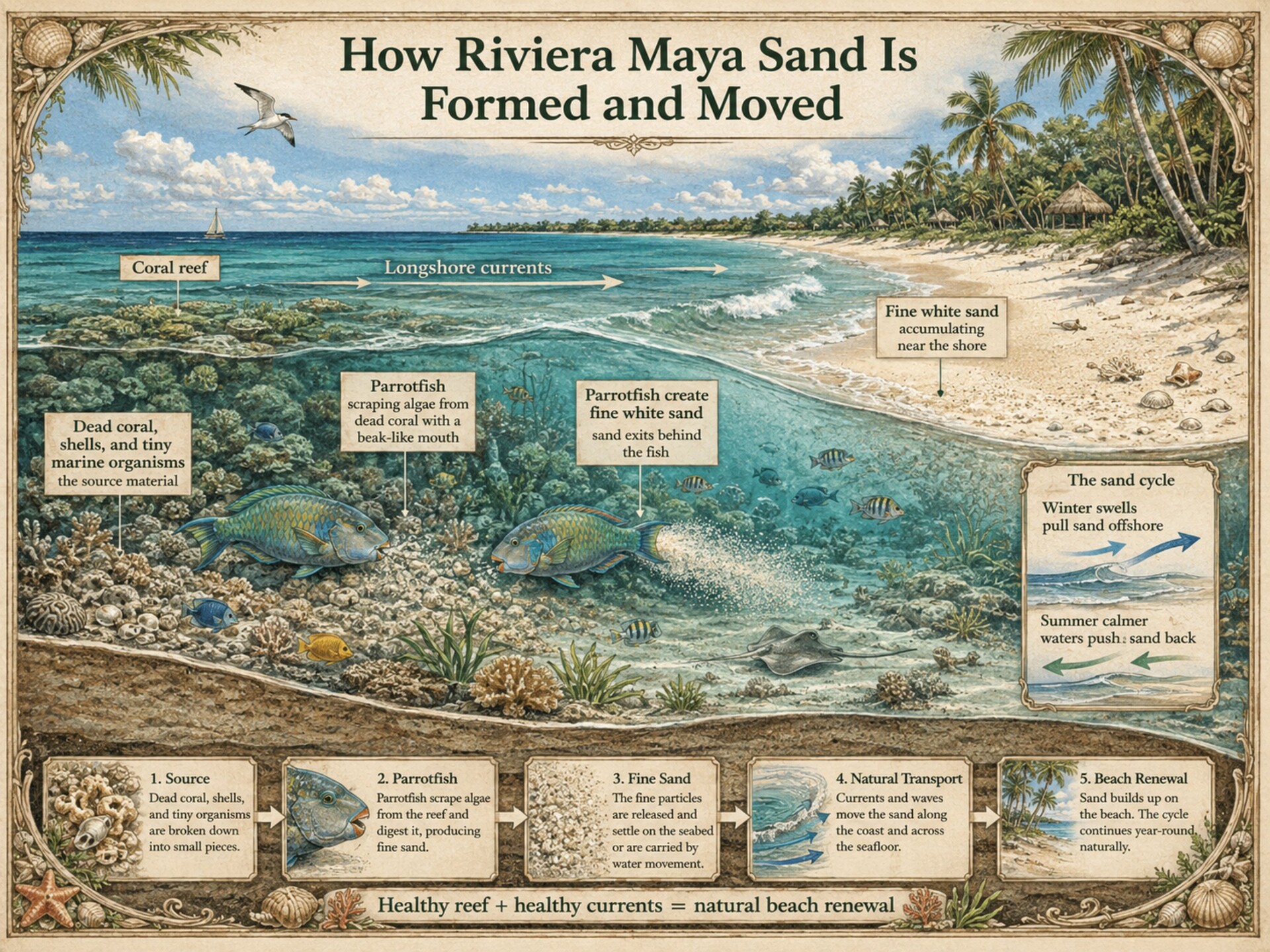
Once that sand exists, longshore currents move it along the coastline in a fairly predictable pattern. Sand pulled offshore by winter swells often gets pushed back onto the beach as the water calms in summer, which is one reason beaches here look different depending on when you visit. A healthy reef and a healthy current system keep this cycle running on their own, no dredging required.
Why Sand Starts to Disappear
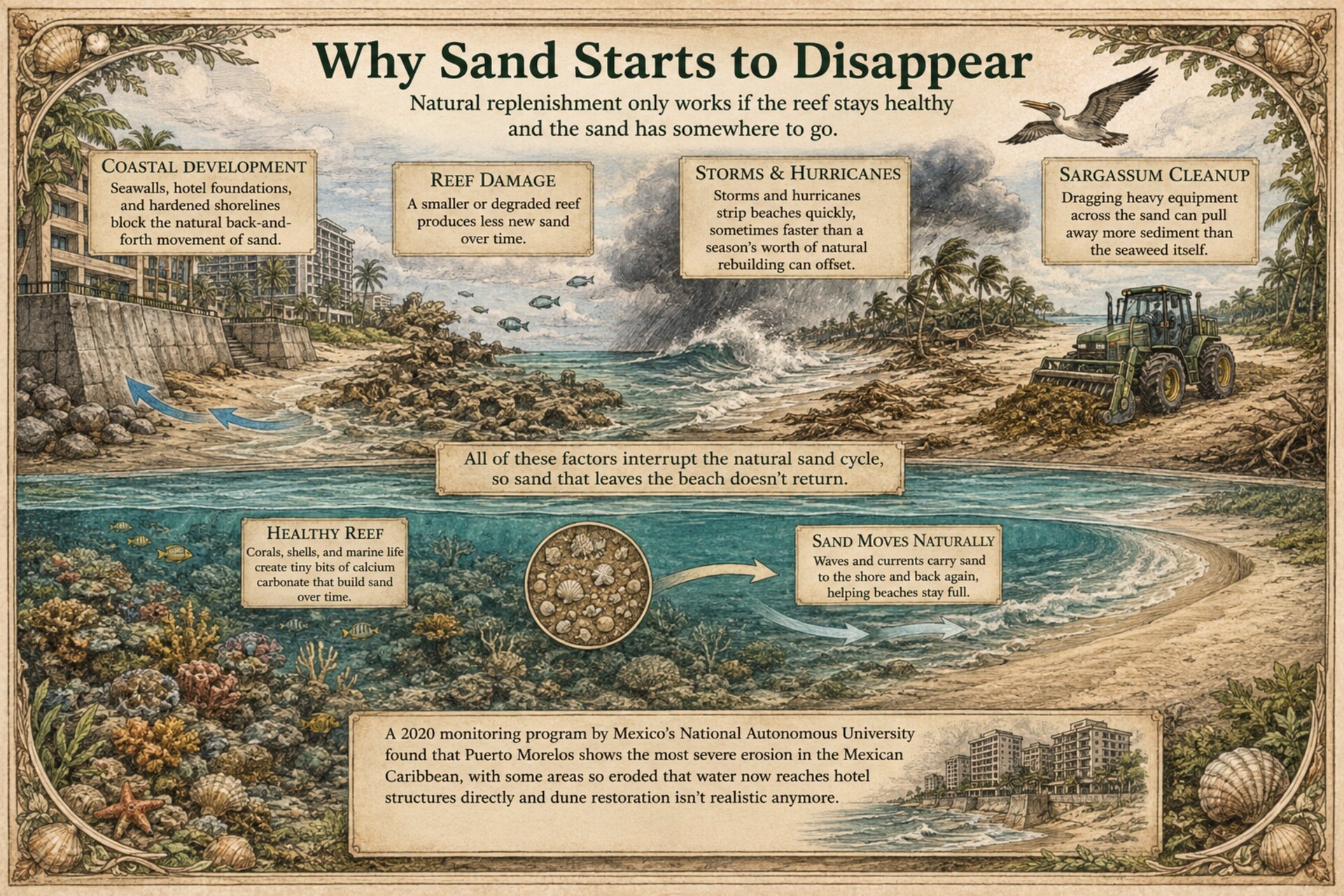
Natural replenishment only works if the reef stays healthy and the sand has somewhere to go. Several things interrupt that.
Coastal development is one of the biggest factors. Seawalls, hotel foundations, and hardened shorelines block the natural back-and-forth movement of sand, so instead of shifting and returning, it gets carried away and never comes back.
Reef damage plays a direct role too, since a smaller or degraded reef produces less new sand over time. Storms and hurricanes strip beaches quickly, sometimes faster than a season's worth of natural rebuilding can offset. Even sargassum cleanup, when it's done by dragging heavy equipment across the sand, can pull away more sediment than the seaweed itself.
A 2020 monitoring program by Mexico's National Autonomous University found that Puerto Morelos shows the most severe erosion in the Mexican Caribbean, with some areas so eroded that water now reaches hotel structures directly and dune restoration isn't realistic anymore.
How Sargassum Actually Affects the Sand
Sargassum's most obvious problem is the smell and the mess, but it does more to the sand itself than most travelers realize.
When large mats decompose directly on the beach instead of being cleared quickly, they can measurably change the sand underneath. A University of Miami study found that sand where sargassum was mixed in rather than removed showed higher arsenic levels than sand where the seaweed was cleared away promptly, since the algae absorbs trace metals from seawater as it grows. That's one reason quick, thorough removal matters more than a photo of a rake and a wheelbarrow might suggest.
The knock-on effects reach beyond any single beach. A peer-reviewed review of the Great Atlantic Sargassum Belt found that heavy landings are linked to beach erosion, a shift from sandy to muddy nearshore sediment, and the loss of seagrass meadows that would otherwise help hold sand in place. Decomposing sargassum also depletes oxygen in the shallow water close to shore, which is part of why seagrass and other sand-stabilizing plant life struggle most in the areas hit hardest and most often.
None of this means a sargassum season ruins a beach for good. Removal practices differ by resort, but daily manual collection and offshore barriers are standard along much of the coast, and sand that's cleared before a mat fully decomposes doesn't carry the same buildup of trace metals or organic matter.
The Role of Mangroves in Keeping Sand in Place
Reef health gets most of the attention, but the mangrove forests behind the beach are doing just as much work, and it starts before a wave ever reaches the sand.
Mangrove roots grow in dense, tangled networks that slow moving water down. As water passes through them, it drops the sediment it's carrying instead of pushing it further along, which is how mangroves build up and hold soil over time rather than just sitting on top of it. That same root structure absorbs wave energy during storms, so a storm surge that passes through a healthy mangrove stand often arrives at the beach with noticeably less force than one that doesn't.
According to SAVE Riviera Maya, a local conservation initiative focused on this coastline, mangrove roots impede water flow and encourage sediment to settle in areas where it's already accumulating, which is exactly the mechanism that keeps sand from washing straight back out to sea.
Remove the mangrove buffer, and beaches lose two things at once: a storm-energy shock absorber and a natural sediment trap. That combination is part of why the areas hit hardest by erosion in this region tend to be places where mangrove and dune vegetation was cleared for development, not just places with weaker reefs.
The same channels that trap sediment double as a habitat corridor. Guests who paddle through a mangrove tunnel on a kayak tour often spot crocodiles that favor these brackish lagoons, along with spider monkeys swinging through the jungle bordering the wetlands. It's a reminder that the sediment trap and the wildlife nursery are the same piece of coastline doing two jobs at once.
What Quintana Roo Is Doing About It
The state government has moved past treating this as a one-time fix. Restoration plans now on the table cover roughly 31 kilometers of coastline, including sections of Cancun, Playa del Carmen, Cozumel, and Puerto Morelos, and officials have shifted emphasis toward nature-based solutions rather than dredging alone.
That means dune rebuilding, reef restoration, and seagrass protection alongside the more visible sand-pumping projects. Officials involved in the plan have been direct that dredging sand onto a beach is a temporary fix on its own. Rebuilding the coral reefs and coastal vegetation that produce and hold sand naturally is the part meant to last.
What this looks like in practice: A couple planning a January trip might notice the beach in front of their resort is narrower than the photos they saw online from a July stay. That's usually the winter swell pattern at work, not a sign the beach is vanishing for good. The same stretch of sand typically widens again by early summer as calmer water lets it settle back onshore.
A Real Tradeoff Worth Knowing
Travelers chasing the widest, softest beach often assume summer is the only good time to visit. But summer also brings peak sargassum season along much of this coast, while winter months usually mean less seaweed and cooler, more comfortable days, even with a temporarily narrower shoreline. Neither season is the "wrong" choice. It comes down to whether beach width or lighter seaweed matters more for your trip.
Final Thought
A beach that looks different from one visit to the next isn't necessarily a beach in trouble. Sand naturally comes and goes with the seasons here, and the reef offshore is quietly rebuilding it the whole time. What actually threatens Riviera Maya's beaches long-term is reef damage and hard shoreline development, which is exactly why the region's restoration efforts increasingly focus on protecting reefs and dunes rather than just moving sand around. Guests planning a stay at Sandos Caracol can see that nature-first approach reflected on-site, where the resort's All-Nature Experience includes guided walks through the mangrove and cenote snorkeling right alongside the beach itself.
Ready to see the coast for yourself? Explore Sandos Caracol Eco Resort to start planning your stay. Guests curious about the wildlife living alongside the mangroves can also read up on the Mexican animals you'll spot during a Riviera Maya stay before they arrive.
Frequently Asked Questions
Will beach erosion affect my trip if I book years in advance? Probably not in a way you'd notice. Erosion trends move slowly, over years rather than weeks, so a beach photo from last season is still a fair guide for a trip booked far ahead. A sudden narrower look on arrival is almost always a storm-season or winter-swell effect, not a sign the coastline changed permanently since you booked.
Can I still enjoy the beach and sand during sargassum season? Yes. Most Riviera Maya resorts run daily cleanup through the sargassum months, and normal beach contact with the seaweed isn't dangerous. Basic hygiene, rinsing off and washing hands before eating, is the main precaution worth taking, especially for young kids who might put sand or seaweed in their mouths.
Does the amount of sand vary a lot between different points along the coast? Yes, more than most travelers expect. Bay-shaped beaches protected by an offshore reef, like those around Puerto Aventuras and Akumal, tend to hold onto more sand than exposed, straight stretches of coastline that take wave energy head-on. It's one more reason two beaches just a few kilometers apart can look noticeably different.
Are resorts doing anything to help protect the beach and reef? Many properties, including Sandos Caracol, run reef and mangrove conservation programs, since a healthy reef is what keeps the natural sand supply going in the first place.
Should I avoid areas where beach restoration work is happening? Not necessarily. Restoration zones are usually marked and managed to keep guest areas separate from active work, though it's worth checking with your resort before booking activities right next to a project site.
Will a narrower beach affect swimming conditions? Generally not. A narrower shoreline changes how much dry sand is available for lounging, but it doesn't usually affect water clarity or swimming safety on its own.
Are the beaches better in Cancun or the Riviera Maya? It depends on what you're after. Cancun's Hotel Zone sits along one long, continuous stretch of coast, so its beaches tend to be wider and more uniform. Riviera Maya beaches, including the ones around Playa del Carmen, are often narrower but feel calmer and less built-up. Neither is objectively better; it comes down to whether you'd rather have more room to spread out or a quieter, more natural setting.
Are the beaches in the Riviera Maya rocky? Most of the coastline is soft white sand, including the beach at Sandos Caracol. A few spots further south, particularly around Akumal, Puerto Aventuras, and Paamul, have limestone or coral-rock sections near the waterline where reef shoes are worth packing, but that's the exception rather than the rule.
Which resort has the best beach in the Riviera Maya? Sandos Playacar and Sandos Cancun are consistently the standout picks. Sandos Playacar sits on a wide, soft stretch of white sand in the gated Playacar community, just a short walk from Fifth Avenue, while Sandos Cancun fronts one of the Hotel Zone's most protected, calm-water beaches, which makes it an easy pick for swimming and lounging alike.